Humans have always looked to the skies for answers. We’ve mapped the stars, named constellations, and written myths about gods and cosmic beings. Before we had telescopes and data, we had imagination and for most of human history, it was enough. Today, even with satellites and supercomputers, we still don’t really understand everything we see. Strange lights, discs in the clouds and craft zig-zagging across the sky. UFOs, UAPs, hallucinations, hope, they remain a persistent mystery.
Where science hesitates to explore the unexplained, artists are more than willing to jump in and throw glitter on it. Despite the growing number of documented sightings (including here in Southern Africa), unidentified aerial phenomena have mostly been ignored or dismissed by scientific institutions. Traditionally, science has leaned on materialism; the idea that everything must be measurable, repeatable, and explainable. If it can’t be tested, it doesn’t count.
As physicist Michio Kaku has said, science is starting to admit that some things fall outside its current toolkit. According to Stephen Hawking and Leonard Mlodinow, multiple models can explain the same outcome — meaning our understanding of “reality” is not fixed, but flexible. In other words, we don’t have to believe to be curious.
As an artist, I’m less interested in what UFO’s are and more fascinated by what it means to see one, or to imagine one. I’m drawn to the space between belief and scepticism, between science and speculation. That’s where imagination lives. Artists have always played with the strange, speculative, and the spiritual. Sci-fi art, in particular, gives form to ideas that might otherwise remain invisible. It turns unprovable theories into bold images and complex feelings into something tactile.
My Dad the Atheist, and Star Trek
My dad was born in 1932. Tough, straight-talking, deeply sceptical, he didn’t believe in gods, ghosts, or even slightly overpriced coffees. A proper atheist. He believed that there were other life forms out there, but little green beings visiting our planet? Not a chance. He once told me that in the comics he read growing up, they imagined humans traveling to the moon, long before it was scientifically plausible. Everyone thought it was nonsense. Then one day, it wasn’t.
We used to talk about those kinds of shifts. He didn’t believe in aliens, but we could both agree that Star Trek was ahead of its time. The idea of seeing someone’s face on a screen during a call? Unbelievable. And robots serving tea? Honestly, I’m still waiting. Those conversations, equal parts eye-roll and awe, shaped how I view the relationship between belief, technology, and imagination. He gave me his scepticism. I turned it into art.
Frank R. Paul: Drawing the Future Before It Arrived
One of my visual influences is Frank R. Paul, the godfather of science fiction illustration. In the 1920s, Paul was already drawing alien cities, robot invasions, and flying saucers…decades before they became pop culture. His work is fascinating because it didn’t just illustrate fiction, it shaped how people imagined outer space. Paul used bold colours and impossible machines to ask the question: What if? Even now, his art reads like a hermeneutic exercise, blending reality, appearance, and interpretation. His alien worlds were never just decoration …they were suggestions. Invitations to reimagine what was possible. As an artist, I see his work as a kind of visual philosophy. A challenge to fixed reality, a reminder that the imagined can, eventually, become real.
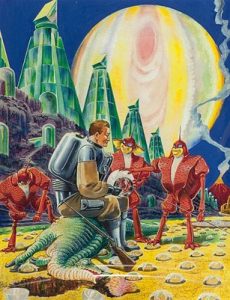
Paul, F. 1940. Life on Europa
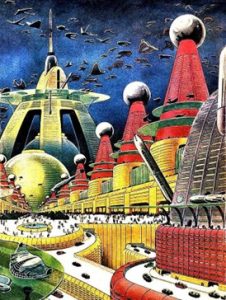
Paul, F. 1942. City of The Future.
UFOs in the Southern African Sky
Unidentified aerial phenomena, yep, UFOs, have been spotted in Southern African skies for decades. Good luck finding organised records or serious studies. Most of what we know lives in oral traditions, scattered reports, and the occasional “you won’t believe this” story shared at a braai. These stories exist, they just rarely make it into the mainstream. That gap fascinates me. Why don’t we take local sightings seriously? What if, instead of brushing them off, we responded with curiosity, or even creativity?
I’m not here to declare what’s real. I’m not making claims about aliens, portals, or strange lights over the Karoo. What grabs me is how people make meaning out of mystery. How art helps us process wonder or suppress it. What we might learn by lingering in that strange, liminal space between fact and fiction. Southern Africa is full of UFO sightings and full of untapped artistic potential. The region’s landscapes, symbols, myths, and stories offer a rich context for reimagining these encounters. Local voices and lived experiences are key. What happens when we treat the weird stuff not as fringe, but as fertile ground for art?
I’m interested in what new stories we might tell and what they might reveal if we look up with open eyes and open minds. We never know what we might find.
May the force be with you.
C

Table Of Contents